Fire-licked Island, Main Island and Orchid Island are so close geographically that they are within one another’s sight. In the fell clutch of circumstance, whether self-imposed or involuntary, they share a turbulent history. Apart from looking back at the ocean current and the crest of tidal waves, they look up at the same starry sky. I plan to associate Hera’s breast milk with island-hopping, with the split space-time under political governance. ( Translations by 2020 Green Island Human Rights Art Festival)
He left the mountains when a red sun arrived and, when the twelve rays of a white sun came, left their slopes again. Having lost his farmland and hunting ground, this Aboriginal warrior came to a place near the sea, where he blossomed like a graceful lily on the bank of a polluted river.
Derived from Paiwan language, “Ljavek”, meaning “a place near the sea”, is the name of the only indigenous community in the center of Kaohsiung City. The community was formed in the 1950s to meet a shortage of labor in the timber and export industries by a group of Paiwan people who had no choice but to move to the city for a better life. In 1997, a canal that used to lie in front of the community was filled and turned into Jhonghua 5th Road. The entire area was later repurposed by the local government as land for urban planning and named “Asia New Bay Area”. Since then, when they were determined to be “illegal occupants”, community members have been engaged in anti-eviction negotiations and protests for 20 years.
A collaboration between Yang Wen-Shan, a Ljavek sculptor known as Kuljelje Balasasau in Paiwan language, and Chang En-Man, Yang Wen-Shan’s unpretentious handiwork aims to initiate a self-healing process for a broken culture by exploring the essence of life and the state of the times, in the hope of composing a preliminary vision of the future. ( Translated by: NTMoFA)
"As Heavy as a Feather", Video installation, dimensions variable, 2016
Kite, bamboo, canvas, projection: 13’ 45”
“As Heavy as a Feather” Main video: 42' 48"
“As Heavy as a Feather” Chapter: Lin Dou: 29’ 44”
The allusion of “Heavy as a feather” is inspired from a Chinese idiom 200 B.C. ago: “The death may be heavier than Mount Tai but lighter than a feather.” The original intention is to point out the way people value themselves and live out their lifes with own value in the limited lifetime.
Here the meaning is reconstructed by altering the sentence. From the inverse semantics, the artist tries to explore how people with tiny power value and look at their own lifes. By portraiting a kind of abstract power through video images, the artist intends to expand own imagination besides from a singular capitalism value.
Shanyuan Bay locates in Taitung county of Taiwan, its traditional name in Amis language is called Fudafudak, means “a glittering place”, it is also name of a small neighbourhood tribe. Same as many other remoted townships, Fudafudak is facing problems of outward migration and culture loss. Meantime, the natural living area of this tiny village is coveted by many large investors for land development project. By following social activists who work for native culture re-built, take advantage of opportunity to exhibit in Canada, the artist enters into the tribe and co-work with the natives: to produce and reappear the huge legendary sound kite. The video also features scenes that elders tell the story of legend Ngayaw from their childhood memories and sing the song of Ngayaw. (Translated by: Lucyann Tung)
藝術家在能盛興工廠短期進駐的一個月裡製作影片,採訪女性成員們描述她們最喜愛的地方,穿插男性口白以一位虛構人物作串場。藉由身體實踐力十足的能盛興工廠成員,以及所連結的社群,淺談台灣近代藝術的發展脈絡,並對所謂的藝術圈做反身性思考。 Neng-Sheng-Xing Factory is located in Tainan, Taiwan. It’s used to be an abundant 3 levels building over than 20 years, now it’s not only a base of dream, but also a place with multi-activities to public after a group of young people refurbished it. The relationship between space and human is strongly related, a space formed by people are the continuously transitions. These transitions are leading with the organic status to a land of dreams or we can interpret it in a more specific definition: Utopia.
The female members described their favorite places when the artists filmed the interviews during the one-month term residency at Neng-Sheng-Xing Factory, they also mixed a male narration as imaginary character in the film. This video is trying to present the development and history of Taiwan Modern Art and offering a reflexivity thought to art circles by the team members of Neng-Sheng-Xing Factory’s practice force. (Translator: Daphne San)
The Happy Mountain is, by all practical accounts, invisible. Located around a seaside highway in northeast Taiwan, Happy Mountain doesn't have any visible mapping points. The people who live there are primarily elders of Amis (Pangcah), cohabiting with the natural environment and sustainably living off the rich resources found between the sea and mountains. They subsist off collecting wild vegetables and seafood, as well as building different types homes by collecting recycled construction materials for the last thirty years.
In Taiwan, many of the urban indigenous tribes are dotted around suburban areas of cities. The typical reason they came to live in these suburban areas —away from their hometowns such as Hualien and Taitung— was to make a better living wage as manual laborers, namely off of the early boom in urban construction. Due to nostalgia and homesickness, these laborers gradually started to gather, one by one, in Happy Mountain due to its geographical similarity with their hometowns.
This type of movement is not unlike how their ancestors began to gather and live together in the past, forced on by the continued development of their country by outside occupation. After those major early develops waned in Taiwan, the land was no longer seen as belonging to these migrant laborers. Instead, the land came into the possession of the government and became just another piece of capital. Therefore, these laborers have now been deemed illegal occupants, treated without the proper respect, for their sacrifices and years of hard work for the collective good of Taiwan. As it stands today, every resident who make The Happy Mountain their home are being accused of illegally occupying National property and face losing the place they worked so hard to call home.
From the outside looking in, Happy Mountain seems like a utopian space, complete with a rare balance found in other parts of Taiwan, that being a harmony and peace within the dedication to sustainability. If anything, the hard work of these people have made it more attractive to outsiders, who now envy and look forward to living there.
En Man's entry into this space was to simply explore this area, soon finding a mysterious house of glass abandoned on the high point of mountain, shrouded within a foggy political atmosphere. En Man uses this kind of loose exploration in order to gradually and unpretentiously build experiences tied to this mountain area and, in so doing, try to recognize and understand the process of mapping from outside to inside, as if looking for the path to some form of hometown.
In 2008, a group of people got to know each other on the occasion of Wild Strawberries Movement. In 2009, they collaborated to run the Go Straight Café as an experimental and open space for the purpose of organizing a community and taking actions. 2012, Go Straight Café closed down. Since then, individuals drifted from one café to another, sitting on unfamiliar sofas till they met each other again. In 2014, Halfway Café hit the road.
Halfway Café is a project as well as a platform for those who lost in directions or languages finding their own place. In order to continue creating publicness, Halfway made an analogy of itself and a country and develops four political routes: currency, mutual aids wall, farming and night canteen.
Above all, Halfway Night Canteen bases on a concept of “a store with another store”(a country inside another country) and puts individual/public self-governance into practice. From Monday to Sunday, a chef of each day cooks thematic meals related to their background in-store. Here, food is a medium for delivering beliefs. It can activate any possibilities and even revolutions. It discloses values that we choose to survive.
a publishing project
En Maan Chang was fascinated by Halfway. She explored the proposed a collaboration. Firstly, she became resident-chef in Halfway Night canteen and got to know the community and the space better. She lately interviewed night canteen chefs and edited it for publishing a trial issue of Halfway Night Recipes in order to understand an individual/collective’s attitude, knowledge, experiences as well as the culture and political position behind. Her intention was to picture a networking and portray a community conscious and even a collective consciousness of utopia.
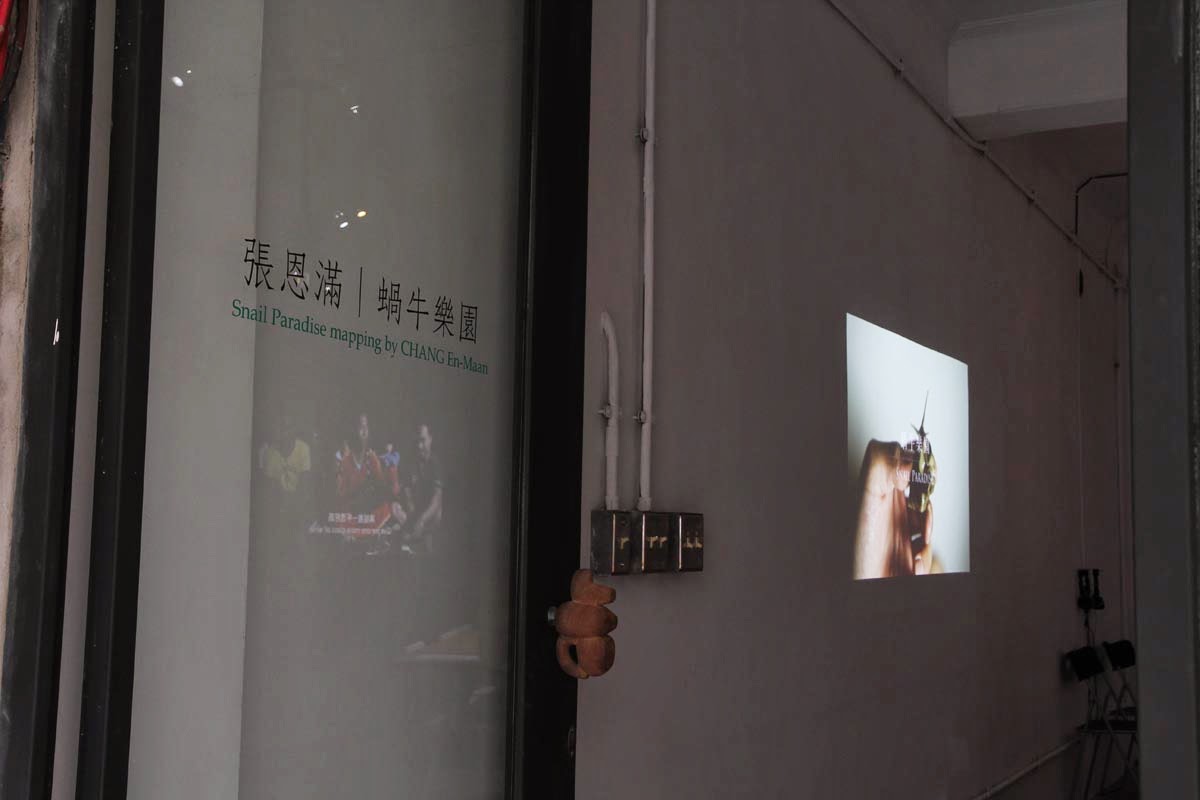
Over two hundred kinds of snails exist in Taiwan, but the giant African snail, an alien species, triggered the artist to embark on a journey in exploring her self identity and geographical identification. Snails constantly secrete mucus, leaving traces wherever they move, allowing them to draw various mind maps through their specific mobility. By the returning visits to the aboriginal tribes and experiencing the social geographical texture of the locale, the artist attempts at mapping the complex food chain-like interconnections of the locality in order to portray its cultural landscape, and continues to unearth and disclose the deeper and viscous relationships in life.
Welcome to Snail Paradise!
--
Translated by : OCAC